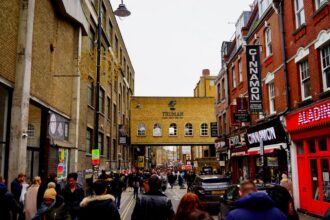
The queue on Boundary Street moves in one direction and it moves slowly, and if you join it on a Friday evening you will spend somewhere between thirty minutes and an hour in it. This is, by most reasonable definitions, a long time to wait for a table. And yet the queue is always there, and the people in it are never quite as miserable as they should be, and the reason for both of those things is a small glass of chai that arrives in your hand shortly after you join it – warm, spiced, complimentary, and quietly making the argument that the restaurant you are waiting to enter has thought about you before you have even walked through the door.
Dishoom is, technically speaking, a chain. It has branches in Covent Garden and King’s Cross and Battersea and Edinburgh and Manchester. The word chain carries implications – consistency over character, formula over feeling – and those implications do not sit comfortably with a restaurant that works this hard at atmosphere and detail. I have eaten at several of the London branches and thought well of all of them. But it is the Shoreditch branch, at 7 Boundary Street, that I find myself returning to and thinking about in a way the others do not quite produce. Not because the food here is radically different from the other locations. Because the address is doing something interesting, and most people walking through the door have not stopped to consider why.
What an Irani Café Actually Is
The entire Dishoom concept is built around a specific and largely vanished institution: the Irani café of old Bombay. These were not simply Indian restaurants. They were something considerably more particular, and understanding what they were is the only way to understand what Dishoom is genuinely attempting.
The origin story
The Irani cafés of Bombay were opened from the early twentieth century onwards by Zoroastrian immigrants from Iran – Parsis and Iranis who had made their way to the subcontinent and found, in the café business, a way to build community and livelihood simultaneously. At their peak in the 1960s, there were close to four hundred of them across the city. They served chai and bun maska and eggs and dal, and they served all of it to everyone – rich businessmen and taxi drivers and students and courting couples and lawyers reading briefs. The bentwood chairs and ceiling fans and stained mirrors were not decor. They were just what the place looked like after decades of being used and loved and not excessively fussed over.
Fewer than thirty of those original cafés survive in Mumbai today. Dishoom was started, in 2010, specifically to keep that spirit alive somewhere – to give London a version of something that Bombay itself was losing.
Why recreating this matters
The thing that distinguishes the Irani café from other restaurant traditions is not the food, which was always straightforward and honest rather than elaborate. It is the posture toward the customer. These were places that welcomed everyone, that stayed open all day, that did not require you to be there for any particular reason. You could nurse a single chai for an hour. You could bring a newspaper. You could arrive alone or in a large group and be equally comfortable. The house rules posted on the walls of every Dishoom branch – No Spitting, No Mischief Making, No Flirting with Cashier – are authentic to the original cafés, and they are funny, but they are also a genuine piece of social history. They describe a public space with standards and eccentricities of its own.
Why Boundary Street Makes Sense
The Covent Garden branch of Dishoom, which opened first, makes a certain kind of sense – a central London location for maximum footfall, a tourist-friendly neighbourhood, an obvious audience. The Shoreditch branch is more interesting. Boundary Street is not a main road. It is a quiet side street just off Redchurch Street, and it runs along the edge of the Boundary Estate – one of the earliest council housing developments in the world, built at the end of the nineteenth century on the rubble of one of London’s most notorious slums. This is not the obvious address for a restaurant with a one-hour queue.
The contradictions the location holds
The Boundary Estate, as anyone who spends time in this corner of E2 will know, is a neighbourhood of considerable quiet dignity – low-rise Victorian brick, leafy communal gardens, Arnold Circus at its heart. It has, improbably, retained a residential character despite the gentrification that has consumed most of the streets immediately surrounding it. Dishoom on Boundary Street sits right at the edge of that world, facing toward the creative and commercial energy of Shoreditch High Street while being physically rooted in something older and more settled.
This is, when you think about it, almost exactly what the original Irani cafés were doing in Bombay – occupying the border between communities, belonging fully to neither, welcoming both. A restaurant built around that tradition landing on this particular street is not an accident of real estate. It is an unusually good fit.
The design as a physical argument
The interior of Dishoom Shoreditch is large – two floors, high ceilings, tiled floors, a long bar in The Permit Room on the ground floor, intimate booths and cosy corners distributed across both levels. The design was executed with deliberate imperfection: blackened mirrors, distressed wooden panelling, family photographs half-hidden in dim light, gently turning ceiling fans. The restaurant’s own description of the aesthetic refers to layers of character built up over years of use, to scratches that are not polished out because they are memory rather than damage.
This is a design philosophy that requires a certain amount of bravery to commit to, because the easier thing is always to make everything look new. In Shoreditch, where the question of what authenticity means in an area that has been continuously reinvented is genuinely live, a restaurant that has thought carefully about accumulated imperfection as a value lands differently than it would in a quieter postcode.
The Food That Earns the Location
The menu at Dishoom Shoreditch is the all-day Bombay café menu – breakfast through to late dinner, the same roster of dishes that made the brand’s reputation and continue to fill the queue outside. Talking about it honestly requires resisting two temptations: the temptation to dismiss it as a chain menu and the temptation to over-celebrate things that are simply very good at what they set out to do.
The black dal
The House Black Dal is cooked for twenty-four hours and it is the dish I would use, if pressed, to explain what Dishoom is doing that most restaurants of its profile are not. It is dark and rich and deeply savoury in a way that patient cooking produces and shortcuts cannot replicate, and it has the quality – rare in a restaurant that serves hundreds of covers a night – of tasting like someone’s grandmother’s recipe rather than a production line. It is not the flashiest thing on the menu. Order it anyway.
What to eat beyond the obvious
The bacon naan roll is genuinely excellent and you should have it for breakfast at least once. But the menu rewards exploration. The okra fries are better than they sound and considerably more addictive than seems reasonable. The lamb chops – charred, deeply spiced, arriving with a particular kind of fragrance that the open kitchen circulates through the whole room – are the centrepiece dish that many regulars quietly consider the point of the whole meal. The lamb raan, a slow-cooked whole leg served with bread for tearing, is the kind of thing you order when you want everyone at the table to be happy simultaneously.
The Queue, Reconsidered
The queue on Boundary Street is the detail that most puts people off Dishoom, and it is also, if you approach it correctly, one of the more pleasurable things about the experience.
What the chai is actually doing
The complimentary chai that arrives in the queue is not a customer service gesture in the conventional sense. It is a direct echo of the original Irani café culture, where the threshold between inside and outside was always permeable and hospitality began before you sat down. That the restaurant maintains this practice across a multi-city operation, when it would be entirely possible to simply not bother, says something worth noting about how seriously Dishoom takes its own reference point.
How to visit without the wait
The queue is largely a dinner phenomenon. Breakfast and lunch on weekdays – particularly on the quieter side of midweek – are reliably queue-free. The Permit Room bar takes walk-ins for drinks even when the restaurant is full, and spending an hour there with a Gimlet and the small plates menu is not a consolation prize. The verandah – Dishoom Shoreditch’s outdoor terrace – is one of the more pleasant places to sit in this part of Shoreditch on a warm evening, and tables there tend to move more quickly than inside. These are the things a local knows, and they make a genuinely good restaurant into a genuinely easy one.