I have two recurring dreams about this neighbourhood. In one, I am standing at the counter of Beigel Bake at two in the morning, mustard on my sleeve, watching a slab of salt beef being pulled from a container that has possibly been going since approximately 1974. In the other, I am at Jolene on Redchurch Street on a cold Tuesday morning, cardamom in the air, cradling something warm wrapped in paper that I have been looking forward to since I woke up.
The two dreams are separated by about forty years of neighbourhood history and about eight minutes’ walk. They are also, in every way that counts, the same dream. Both are about bread. Both are about the particular comfort that bread provides when it is made properly and eaten somewhere you love. And both are, in ways I have been thinking about for most of my life, entirely Shoreditch.
This neighbourhood has always had a thing about bread. What has changed is the kind.
The Two Shops on Brick Lane
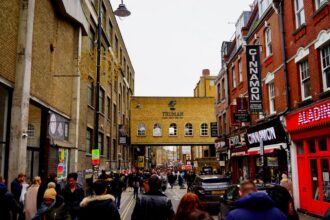
At 155 and 159 Brick Lane, two doors apart from one another, stand the Beigel Shop and Beigel Bake – the yellow one and the white one, as they are known to anyone who has spent more than a week in E1. They are open twenty-four hours a day, seven days a week, every week of the year. They have been here, in these forms, for decades. They are each other’s closest competitor, nearest neighbour, and fiercest point of local debate.
The white one and the yellow one
Beigel Bake at number 159 has been operating since 1974, when it was founded by brothers Amnon Cohen and Sammy Minzley, drawing on a Jewish baking tradition that had been part of the East End long before the shop itself existed. The Beigel Shop at number 155 is older still – a bakery has occupied that site since at least 1855, making it one of the longest continuously running food businesses in this postcode by some distance. The current family took the shop over in 1987. In 2002, they renamed it the Beigel Shop – the Yiddish spelling a deliberate nod to origins that matter.
The debate over which is better has been running in this neighbourhood for as long as both have been open. It is, I would argue, the wrong debate. Both are excellent. Both produce the real thing. Both are staffed by people who have been doing this for years and have absolutely no interest in explaining themselves to you. The meaningful distinction is one of atmosphere rather than quality: the white one tends to be louder, faster, more theatrical about the whole business; the yellow one is slightly quieter, slightly more its own world. On a weekend night, this distinction evaporates entirely and both are simply heaving.
What a proper beigel actually is
The beigel – and it is a beigel here, not a bagel, the spelling carrying the weight of the Yiddish word it comes from – is made in a specific way that most of the round bread things sold under that name elsewhere are not. The dough is proofed, then boiled, then baked on wooden planks, a method that produces a crust that is genuinely shiny and a crumb that is dense and chewy in a way that has nothing to do with the soft, pillowy imposters sold in supermarkets. The Beigel Shop still uses what they describe as a 150-year-old method. On weekends, they make up to ten thousand of them.
The filling to order is the salt beef beigel – hot, with mustard and a gherkin if you want one – and it is one of the few dishes in this neighbourhood that tastes exactly the same as it did thirty years ago. This is not nostalgia. This is consistency in the service of something worth preserving.
How the Beigels Got Here
The beigel shops of Brick Lane did not arrive on this street by accident. They are the direct legacy of the large Ashkenazi Jewish community that settled in Spitalfields and Whitechapel from the late nineteenth century onwards – migrants from Eastern Europe who brought with them a baking tradition that had been part of Jewish life in Poland, Russia, and the Baltic states for centuries. The beigel was already ancient by the time it arrived in East London. The first documented reference to the word dates to 1610, in the community regulations of the Jewish Council of Krakow.
The neighbourhood that shaped the bread
By the early twentieth century, Brick Lane was densely populated with Jewish families, bakeries, and synagogues – the infrastructure of a community establishing itself in a new place. The beigel shops were not novelties; they were necessities, producing affordable bread around the clock for workers and families who needed feeding at hours when other options had closed. The twenty-four-hour model was not a marketing decision. It was a response to a community that worked long and irregular hours and needed to eat.
The 2024 closure and what it told us
In February 2024, the Beigel Shop closed without warning. A repossession notice appeared on the door. The reaction across the neighbourhood was one of genuine alarm. A GoFundMe raised money to reopen it. Food writers and locals and people who had not been to Brick Lane in years expressed, with notable feeling, that something irreplaceable had nearly been lost.
The shop reopened in June 2024, now run by the children of long-standing owner Aron alongside his sister Mazal’s family. The episode was uncomfortable and then, ultimately, reassuring – but also clarifying. It showed how much of what we think of as Shoreditch’s identity is actually located in a handful of very old, very ordinary-looking businesses we take for granted until the moment they are threatened.
The New Wave and Where It Settled
In the last decade, a different kind of bakery has established itself across Shoreditch – smaller, quieter, Scandinavian in influence, cardamom-scented, and operating on the premise that the person standing at the counter is interested in provenance as much as hunger. These are not the same thing as the beigel shops and are not trying to be. They represent a different chapter of the same long story.
Fabrique under the arches
Fabrique is a Swedish bakery that originated in Stockholm and has a Shoreditch outpost tucked under the railway arches on Geffrye Street in Hoxton, five minutes’ walk from Brick Lane. The kanelbullar – Swedish cinnamon buns, fragrant with cardamom and baked in stone ovens with organic flour – are what most people come for, and justifiably so. They are chewy in the middle and slightly crisp at the edges and spiced in a way that is deeply present without being aggressive. The sourdough, made with a twenty-four-hour fermentation process, is the other reason to come and the reason people carry a whole loaf home on the bus.
The setting – a railway arch, outdoor seating, bags of flour visible from the counter – has the unhurried quality of a place that is doing one thing and doing it with complete conviction. It suits the neighbourhood well.
Jolene on Redchurch Street
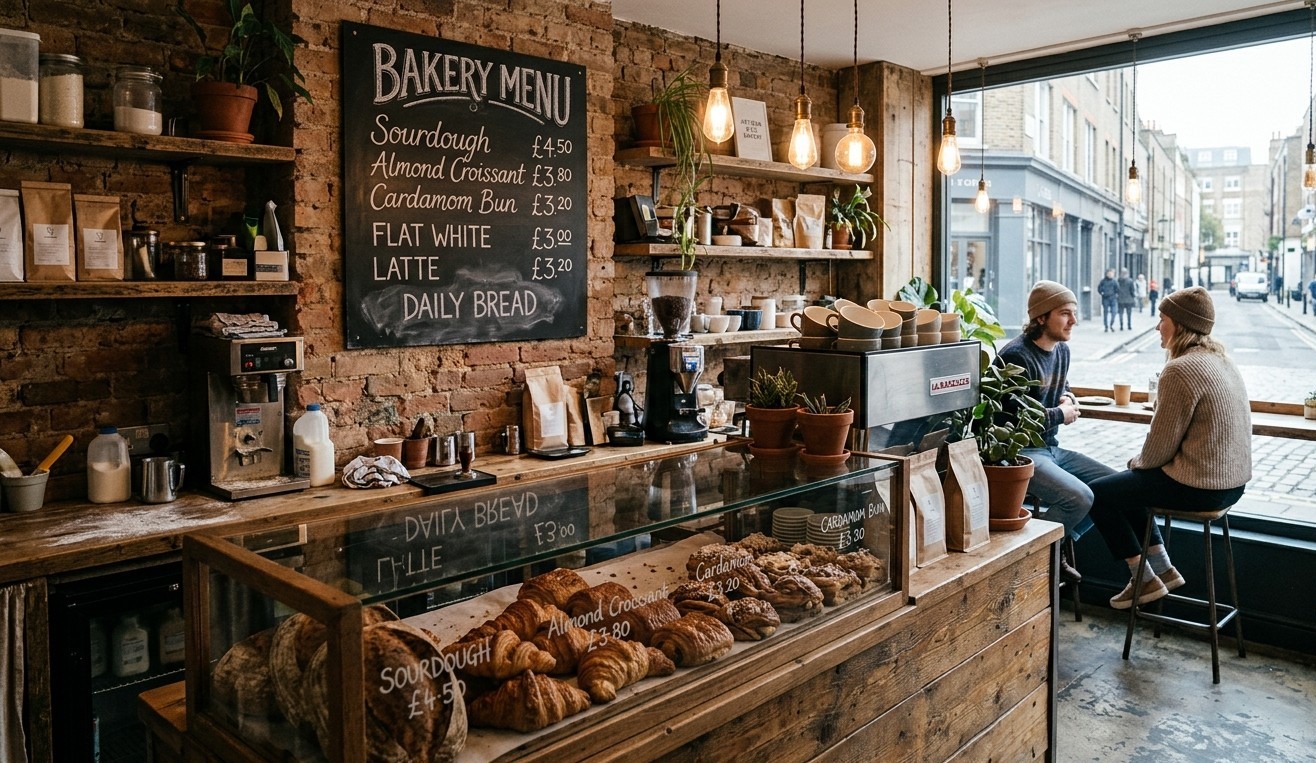
Jolene’s Redchurch Street bakery is tiny. It is, genuinely, a small corner room – pastries laid out on baking paper with handwritten labels, a short queue that moves steadily, the smell of the morning’s bake still present at noon. Jolene mills its own flour daily, which is the kind of detail that sounds like affectation until you taste the bread and understand that it is not. The croissants are properly layered. The cinnamon buns have the right pull to them. The sausage rolls at lunchtime have a following that their understated presence does not fully explain until you have eaten one.
What Jolene does on Redchurch Street is similar, in its essential logic, to what Leila’s does on Calvert Avenue – it occupies a small space with great ingredients and minimal ceremony and trusts the quality to do the explaining. In a street that has absorbed a great deal of noise over the past fifteen years, this restraint is its own statement.
The Same Story, Different Chapters
The beigel shops and the new-wave bakeries of Shoreditch are not in competition. They are separated by price point, clientele, opening hours, and almost every detail of the experience they offer. What they share is the thing that has always been true of this neighbourhood’s food culture: it was built by people who came from elsewhere and brought something with them.
The Eastern European Jews who built the beigel shops brought a bread tradition that was ancient, practical, and communal. The Swedish bakers who set up under the railway arches brought stone ovens and cardamom and a philosophy about fermentation. The question of what Shoreditch bread looks like is always, in some sense, the question of who has recently arrived and what they carry.
What Josie does on a Saturday morning
My preferred Saturday involves both ends of this story. Early, before the Columbia Road flower market has properly started and Redchurch Street is still quiet: Jolene, a flat white, one thing from the counter that smells the best. Then, at some point in the afternoon or evening, or at two in the morning if the night has gone a particular way: Brick Lane, the yellow one or the white one depending on the queue, salt beef with mustard, eaten standing up on the pavement because that is the correct way to eat it.
The same street. The same obsession. Different bread. This neighbourhood contains, within about a mile of walking, the full span of what it means to care about what you make and feed to people. That is, as far as I am concerned, precisely what Shoreditch is for.